Have you ever found yourself in a fast-flowing vinyasa class, feeling completely lost during transitions? One moment you are in plank, the next you are lowering down, and suddenly your shoulders feel overloaded.
I remember my first few months on the mat clearly. Every time the teacher called out Chaturanga Dandasana, my arms shook wildly. I felt like I was collapsing under my own weight. It was frustrating because the pose looked simple, yet my body felt completely unprepared.
That experience is more common than many people realize. Chaturanga Dandasana, also called the Four-Limbed Staff Pose, is one of the most commonly misaligned postures in modern yoga classes. Although it appears to be a simple transition, it requires strength, control, and precise body awareness.
Interestingly, learning this movement can support progress in more advanced yoga skills later. If you have been practicing Shirshasana for beginners, you already know how important shoulder stability and core control can be. The strength and awareness developed here may support more confident movement throughout your practice.
In this guide, you will learn how to practice Chaturanga safely, avoid common mistakes, build strength, and create a smoother, more confident flow.
What Exactly is Chaturanga Dandasana?
To understand this posture, we must break down its traditional Sanskrit name.
“Chatur” means “four.”
“Anga” means “limbs.”
“Danda” means “staff.”
“Asana” means “seat” or “posture.”
Your body essentially becomes a straight, rigid staff supported by just four contact points: your hands and feet.
In Western fitness, people often compare this movement to a standard low push-up. However, the alignment mechanics are completely different. A gym push-up relies heavily on your chest muscles with elbows flaring out wide.
This posture demands that your elbows hug your ribs tightly, shifting the load to your triceps and serratus anterior. It is a full-body integration that requires coordinated engagement across the whole body. When done right, it feels like floating. When rushed, it can stress your joints.
How to Do Chaturanga Dandasana: Step-by-Step Instructions
Safe execution requires mindful alignment from the ground up. Do not rush through this transition during your flows. Treat it as a destination, not just a quick pit stop between other movements.
Step 1: Establish the Perfect High Plank
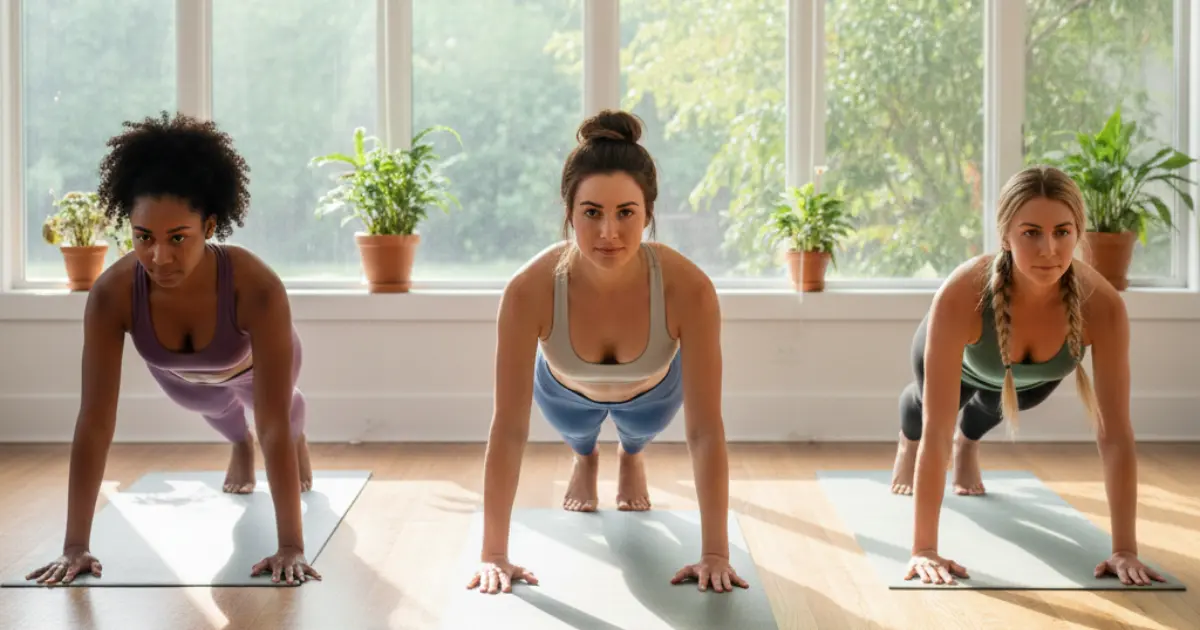
Start in a solid high plank position.
Place your hands exactly shoulder-width apart on the mat.
Spread your fingers wide and press firmly through your knuckles.
Your shoulders should sit directly over your wrists.
Push your heels back forcefully to activate your quadriceps.
Your body must form one long, straight line from head to heel.
Step 2: Shift Your Weight Forward
This is the hidden step most beginners miss entirely.
Rock forward on your tiptoes.
Move your shoulders slightly past your wrists toward the front of the room.
This simple shift changes the angle of your arms.
It ensures your forearms can remain perfectly vertical when you lower down.
This vertical alignment protects your delicate wrist joints from excessive compression.
Step 3: Lower with Total Control
Engage your lower abdominal muscles tightly.
Keep your gaze fixed slightly forward on the floor.
Inhale deeply, and as you exhale, bend your elbows straight backwards.
Keep your elbows hugging the sides of your torso.
Lower your body down toward the floor slowly.
Stop lowering the exact moment your upper arms are parallel to the ground.
Step 4: Hold and Stabilize the Shape
Do not let your shoulders drop lower than your elbows.
Your elbows should form a perfect 90-degree angle.
Keep your chest open and broad across your collarbones.
Draw your belly button in toward your spine.
Keep your legs active and your neck completely long.
Hold this intense position for one full, steady breath cycle.
Step 5: Transition Safely Forward
From this low position, you will typically transition smoothly.
Press through your toes and scoop your chest forward and up into upward-facing dog.
Alternatively, you can press straight back up into a high plank to build stamina.
Always move with intention, never letting gravity drop you heavily onto your mat.
Muscles Worked in Chaturanga Dandasana
Chaturanga Dandasana is a full-body strength posture. While the arms control the movement, the entire body works together to create stability and alignment.
Primary muscles:
- Triceps
- Serratus anterior
- Pectoralis major (chest)
- Rectus abdominis
- Transverse abdominis
- Quadriceps
Secondary muscles:
- Deltoids
- Rotator cuff muscles
- Forearms
- Glutes
- Upper back stabilizers
When practiced correctly, Chaturanga teaches your body to move as one connected unit rather than relying only on arm strength.
Physical Benefits of the Four-Limbed Staff Pose
The physical rewards of mastering this movement are truly profound. It acts as a comprehensive strength-building tool for your entire muscular system.
Dynamic Wrist and Arm Strengthening: This posture places a healthy, controlled load on your upper body extremities. It builds exceptional strength in your triceps, biceps, and forearms. Over time, weight-bearing practice may help support healthy bone loading when practiced safely. This deep structural reinforcement prepares your body for advanced arm balances later in your journey.
Advanced Shoulder Girdle Stabilization: Your rotator cuff muscles must work dynamically to keep you stable. It strengthens the serratus anterior, the muscle wrapping around your ribs.
“Proper alignment in this transition trains the shoulder blades to lie flat against the rib cage, preventing dangerous winging and protecting the rotator cuff.” — Sports Biomechanics Specialist
This stabilization counters the rounding effect caused by sitting at desks all day. It may help improve postural awareness over time.
Deep Core Integration: You cannot hold a proper staff shape with a relaxed stomach. Your rectus abdominis and transverse abdominis must fire completely to support your spine. This action prevents your lower back from sagging toward the floor. It builds functional core strength that protects your lower back during heavy lifting in daily life.
Mental Benefits: Developing Grit and Mindful Presence
The benefits of both mental and physical alignment merge beautifully in this posture. It challenges your brain just as much as your muscles.
Building Emotional Grit and Stamina: This movement forces you to confront physical discomfort safely. When your arms shake, your mind naturally wants to give up. Staying in that intense moment builds profound emotional resilience. You learn that you can handle brief moments of stress without panicking or collapsing.
Enhancing Mind-Body Interoception: Interoception is your ability to sense the internal state of your body. Because this pose requires simultaneous full-body activation, it sharpens your internal awareness. You must monitor your feet, core, shoulders, and breath all at once. This deep focus pulls you completely into the present moment, acting as a moving meditation.
Essential Breathing Techniques for Fluid Transitions
Your breath is the fuel that powers this intense movement. Moving without proper breath support makes the pose feel twice as heavy.
The Power of the Exhale: Always lower down on a steady, controlled exhalation. The exhale naturally contracts your core muscles, providing built-in spinal protection.
Ujjayi Pranayama: Utilize the classic ocean breath to maintain internal heat and focus. The slight constriction in your throat keeps your energy steady and calm.
Avoid Holding the Breath: Freezing your breath traps tension in your neck and jaw. If you cannot breathe smoothly, it means you need to scale back the intensity.
Simple Modifications for Different Skill Levels and Bodies
Every single body is unique, and the standard version of this pose is not accessible for everyone right away. Use these smart variations to build strength without risking injury.
The Knees-Down Variation:
Start in your high plank, then gently lower your knees straight down to the mat.
Keep a straight line from your knees up to your shoulders.
From here, shift forward and lower your upper body down halfway.
This modification cuts the weight your arms must lift by nearly half, allowing you to perfect your elbow alignment.
Utilizing Yoga Blocks Under the Shoulders:
Place two foam blocks at the top of your mat on their highest or medium setting.
Position them directly where your shoulders will land.
As you lower down, let the front of your shoulders rest gently on the blocks.
This setup physically prevents you from dropping too low, keeping your joints safe.
Wall Chaturanga for True Beginners:
If you are recovering from an injury, take the practice to a wall.
Stand a few feet away and place your hands flat against the surface.
Bend your elbows and lower your chest toward the wall, keeping your elbows tucked in tightly.
This variation allows you to learn the movement pattern with minimal gravity.
Common Mistakes and How to Avoid Shoulder Pain
Small alignment errors can lead to repetitive strain over time. Watch out for these three common pitfalls during your practice.
The Sagging Banana Hips: When your core gets tired, your hips naturally drop toward the mat. This creates an unsafe arch in your lower lumbar spine. If you feel a pinch in your lower back, immediately drop your knees down. Keep your tailbone slightly tucked to keep your spine safe.
Flaring the Elbows Outward: Letting your elbows wing out to the sides places immense pressure on your anterior shoulders. It can easily pinch the delicate tendons inside your rotator cuff. Imagine you are trying to squeeze a small beach ball between your elbows and your ribs at all times.
Dropping the Shoulders Too Low: Dipping your chest below the level of your elbows is highly problematic. It forces the head of the humerus bone to slide forward out of its socket. Stop your descent early. It is always much better to lower down just a few inches with perfect control than to drop to the floor with poor form.
The Sacred Roots: History of the Sacred Staff Pose
To truly appreciate this movement, we must look at its origin within ancient Indian traditional yoga culture. While many believe vinyasa flows are modern, their roots connect to deep spiritual practices.
The concept of the Danda, or staff, carries heavy symbolic weight in Indian philosophy. A staff represents discipline, straightness, and unyielding strength. It reminds us to stay steady on our spiritual path, regardless of the challenges we face.
Modern Chaturanga Dandasana became widely recognized through twentieth-century flowing yoga systems and is now commonly included in many Sun Salutation variations.
Today, many practitioners use this pose to build strength, body awareness, and smoother movement between postures.
Safety Contraindications: When to Modify or Skip It
Yoga is a tool for healing, so always listen to your body’s warnings. Avoid the full expression of this pose if you are managing any of these conditions:
Advanced carpal tunnel syndrome or severe wrist inflammation
Recent rotator cuff tears or shoulder surgery
Late-stage pregnancy (utilize the wall modification instead)
Acute lower back pain or slipped discs
Summary Checklist for Daily Practice
| Alignment Zone | Quick Mental Cue | Mistake to Avoid |
| Hands & Wrists | Spread fingers wide, shift weight forward. | Allowing wrists to wrinkle or compress. |
| Elbows | Hug the ribs tightly like a bird folding wings. | Letting elbows flare out to the sides. |
| Hips & Spine | Pull belly in, keep heels pressing back. | Letting the belly sag down toward the floor. |
| Shoulders | Keep them level with your elbows. | Dropping the chest too close to the mat. |
Take Action: Step onto Your Mat Today
Building a strong Chaturanga Dandasana is a gradual process that demands consistency. It does not happen overnight, and that is completely fine. Embrace the modifications and respect where your body is today.
Are you ready to transform your vinyasa practice? Roll out your mat right now. Try the knees-down variation for just three mindful breaths, focusing entirely on keeping your elbows tucked.
Focus on steady progress, good alignment, and consistent practice.